Jul the 05 Corporate
Volleyball Voices: Leah Mitsuing
As a part of the Truth and Reconciliation process, Volleyball Canada is seeking Indigenous Peoples within the volleyball community to share their stories. Our hope is to bring awareness to the broader volleyball community about the Indigenous cultures that volleyball athletes come from and to bring awareness about the past that their people have endured, recognizing the barriers and challenges Indigenous People have faced and continue to face today. Ultimately, we hope to highlight the tangible steps we can all take to ensure volleyball is an inclusive and enjoyable sport for everyone.
Leah Mitsuing (Crookedneck) is from Makwa Sahgaiehcan First Nation in Western Saskatchewan, where she developed a love for volleyball.
Looking up to her father, who also played the sport, she ended up playing for Team Saskatchewan in the 1999 Western Canada Summer Games, before moving on to play a semester at Trinity Western University in 2002. She then played for the Portage College Voyageurs from 2003-2006.
She stayed close to Portage after her playing days were over, stepping into the role of head coach in 2010.
Now, Leah is an advocate, consultant, registered social worker and counsellor, but remains connected to the sport and those she grew up playing with.
Volleyball Canada recently had a chance to chat with Leah to discuss her connection to the sport, the challenges she faced, and what steps can be taken to make volleyball more inclusive moving forward.
Volleyball Canada: How were you introduced to volleyball?
Leah Mitsuing: I was introduced to volleyball by my father. He trained me and helped me to pursue volleyball at club level, Indigenous Games level, and provincial level from grades 8-12.
VC: What helped you stay connected to the sport and do you think it will be a lifelong connection?
LM: My volleyball family. I am still connected to the Nehiyo (Native) volleyball family from when we were kids. The love and passion I have for the sport will stay with me the rest of my life. I continue to this day to go watch university-level volleyball and Team Canada when I have the opportunity.
VC: What is your favourite Indigenous volleyball experience?
LM: My favorite experience is playing college level with my sisters, my cousin, who was our setter, and our friends, with who we played money volleyball tournaments all our lives. We were able to play ACAC conference volleyball together. My very favorite moment was when we played the Northern Alberta Institute of Technology (NAIT) and our head coach at the time could not make it, so our coach was my father. And we won. Our college team was made up of mostly First Nations players and we did well at the time against big colleges such as NAIT. Having my little sister Tamathy and I, both finishing one and two in kills for stats for the North, was also something I am very proud of.
VC: What is one thing that you would like to share with non-Indigenous people about being an Indigenous volleyball player?
LM: I experienced many moments of racism and exclusion in the volleyball levels I pursued. I was often isolated because of my colour. I was made fun of secretly by team members and no one practiced with me in practices, only the assistant coaches because I never had someone come and include me. So I would say to non-Indigenous people to include, invite, and continue including even if they are uncomfortable. Don’t let them be left out. If you are a coach, watch out for them. Racism doesn’t have to be outward for it to exist. Lift them up and encourage them. Many of our people come from places of hardship.
VC: Did you have a favourite Indigenous player when you were growing up?
LM: My favorite player was my dad. He played co-ed and men’s tournaments. He had always taught me that to be the best you had to excel at every skill, and play smart. It wasn’t just power.
VC: Who were your biggest supporters ?
LM: My biggest supporters were my mom and dad, and my First Nation community.
VC: What does volleyball community mean to you?
LM: It means family to me. It means respect, shared love, and passion for a wonderful sport.
VC: Do you think there is a place for conversations of reconciliation in the sport of volleyball?
LM: Absolutely there is a place for reconciliation in volleyball. How we were treated back then is a reflection of the ideologies of past perceptions that still exist today. Why not talk about these experiences and change it? Have our volleyball community be educated about reconciliation and First Nations history. Can you imagine the strength in your teams, the increase of First Nations participation, and confidence First Nations people could have if this was done?
VC: Volleyball Canada is making moves to contribute to Reconciliation; do you have any advice for athletes and coaches who are new to learning about Truth and Reconciliation?
LM:
· Be open and honest. Be truly reflective about your own thinking and how everyone’s past plays a part.
· Being open to see the vision of how understanding and making moves to truth and reconciliation makes a difference.
· Realizing that it comes from the heart. A love and passion for the sport. That this love we all share, and it carries on to each person that has that shared love.
VC: What can national/provincial sport organizations, clubs, or teams do to support positive experiences in volleyball for Indigenous peoples?
LM:
· Include; provide opportunities for club volleyball and tournaments on First Nations lands.
· Teams celebrate and understand the territories and history of the people where their teams are located. You can celebrate by using venues, supporting athletes, celebrating athletes, and celebrating and learning history, through culture and art.
· Many teams have worked with indigenous artists for posters, jerseys, and logos to celebrate the culture and history.
· Acknowledge movements such as Missing and Murdered Indigenous Women (MMIW), Every Child Matters, etc.
Out of respect to the interviewees and their experiences, Volleyball Canada reached out to Holly Rae Yuzicapi from the Standing Buffalo Dakota Nation in Southern Saskatchewan to conduct these interviews. Holly has a deep connection with volleyball and is an instructor of cultural arts, traditional food, and traditional games, facilitating workshops for all ages throughout Canada and the United States.
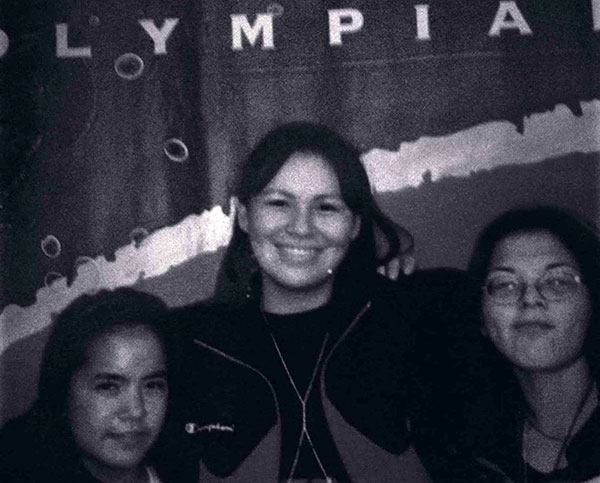
Photo courtesy of Leah Mitsuing (centre)